Pluralism, Narrative & Communications, Social Connection, Trust
27 June 2025
August 14, 2026
Current Events
American Identity
Dialogue across differences and free speech on college campuses have become hot button issues in American public life. More in Common partnered with the Arthur Vining Davis Foundations to understand how students, faculty, and the public actually perceive dialogue and free expression in higher education.
We surveyed 2,004 undergraduate students and 209 faculty and staff at four-year institutions. The survey included a framing experiment on dialogue, measured motivations and barriers to engaging across difference, tested terms commonly used in campus dialogue programming, and examined how perceptions of dialogue relate to perceptions of free speech.
We paired the survey with an in-depth social listening effort. Using Brandwatch, we tracked two years of online conversations, from Summer 2024 to Summer 2026, through key terms such as “free speech” and “dialogue,” and by identifying key events, sentiments, and the audiences driving these conversations about U.S. college campuses.
Here are our key findings.
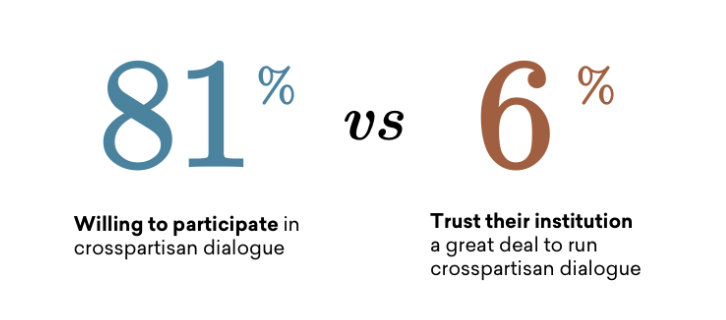
Eight in ten students (81%) say they are personally willing to listen to very different political views. Yet more than half (55%) express uncertainty or little trust that a program run by their institution will be genuinely open and not politically motivated, and only 6% trust their institution “a great deal.” This pattern of distrust is similar across liberal, moderate, and conservative students.
We described the same hypothetical campus program—helping students engage constructively across differences—to five randomly assigned groups, changing only the stated purpose of the program. All five framings were well liked, but the version framed as a program to “build skills that employers value” generated the most interest in participating among students (+32% net).
All dialogue-specific terms (civil dialogue, constructive dialogue, dialogue, dialogue across differences, dialogue across disagreement) are seen as positive (between +46% to +25% net positivity for students). Compared to just “dialogue” (+40%), “civil dialogue” (+46%) and “constructive dialogue” (+41%) are more positively perceived, and civil dialogue performs especially well with conservative students (+55%).
Almost every term we tested, including the dialogue-specific terms, was perceived as left-leaning. The same was true of all five program framings. But how a term was politically perceived did not align with how favorably students and faculty/staff rated it. Students and faculty rated these terms favorably regardless of where they placed them politically. For example, conservative students saw “belonging” as left-coded (+19%) and rated it +58% net positive.
The reasons students don’t engage in dialogue across differences are dominated by social risk. This includes fear of combative or unproductive argument (35%), social judgment (26%), and not feeling safe enough for honest disagreement (25%). For faculty/staff, the same social concerns appear alongside a distinct layer of institutional and professional risk.
A plurality of students (34%) wants both free speech protections and dialogue programs to fight polarization. Yet when asked about the relationship between free speech and dialogue, students are more likely to see the two as often in conflict (36%) than as reinforcing each other (27%).
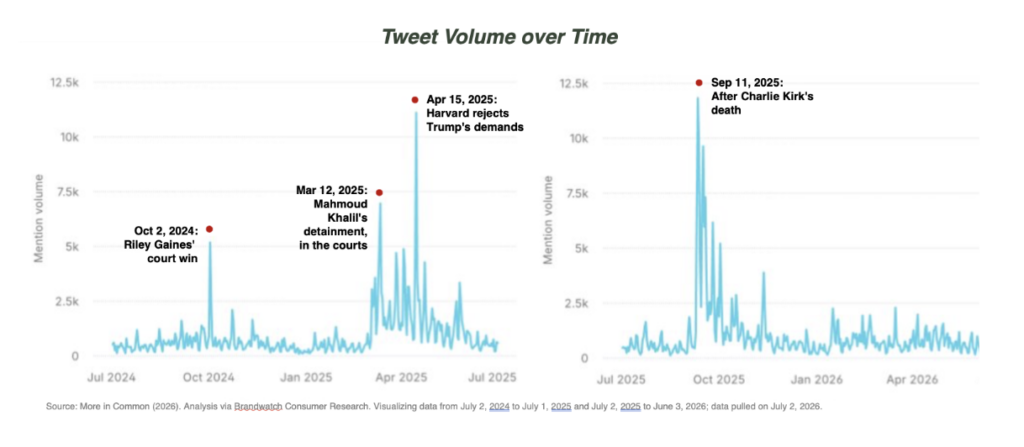
Discourse spikes around major moments—Riley Gaines’s court win, ICE’s detainment of Mahmoud Khalil, Harvard’s rejection of the Trump administration’s demands, and Charlie Kirk’s death—and even during quiet periods, conversations keep circling back to them.
Sentiment is heavily negative for free speech, and while dialogue reads somewhat less negative, it is used much less frequently online than free speech.
Free speech is the more commonly used and more polarized term, most often tied to Trump, and most often evoked in discussions of rights or grievances. Dialogue is softer in tone, used less frequently, and most associated with Charlie Kirk in online conversation.
Top online posters about free speech and dialogue on college campuses skew older, tend to be male, and are more likely to be parents or employed adults than current students.
Columbia University generates far more free speech and dialogue discourse online than any other university in our analysis , with Israel/Palestine-related campus conflict featuring prominently.
More in Common conducted this survey research on behalf of the Arthur Vining Davis Foundations from April 24 to May 26, 2026 via College Pulse. We sampled 2,004 undergraduate students and 209 faculty and staff at four-year institutions, with quotas targeting 50% from Top 50 US News-ranked institutions, 25% from institutions ranked 51–150, and 25% from unranked or lower-ranked institutions.
The margin of error is ±2.2% for students, ±6.8% for faculty/staff, and higher for subgroups. Subgroup analyses within faculty/staff should be interpreted with caution given the sample size.
We conducted subgroup analyses across all items examining ideology, gender, race, and institution tier using US News rankings. We found few meaningful subgroup differences across most items and demographic groups. Ideological differences were the most consistent exception, and we note findings where those differences were substantive.
More in Common completed all analysis via Brandwatch’s Consumer Research, which is a social listening and consumer intelligence platform for collecting and analyzing public online conversations.
It aggregates data from over 100 million sources such as social networks, blogs, forums, news sites, review sites, and video platforms, and has full firehose access to X (Twitter), Reddit, and Tumblr, alongside coverage of Instagram, Facebook, LinkedIn, and TikTok. Mentions are captured using Boolean queries defined by keywords and criteria, then analyzed for volume, sentiment, key topics, and demographics using proprietary machine-learning classifiers and large language models.
This analysis covered two years of data (summer 2024 through summer 2026), using key terms such as “free speech,” “constructive dialogue,” and “civil discourse,” combined with
“campus” and “university.” The primary focus was X (Twitter). Content was only in English,
and only came from users based in the United States.
All figures are exported from Brandwatch; all supporting quotes are from X users.
Eight in ten students say they are personally willing to listen to very different political views.
only 6 percent of students trust their institution “a great deal” to run crosspartisan dialogue
When asked to describe dialogue initiatives at colleges and universities generally, only one in ten (10%) of students call them meaningful and genuine.
Explore the depth of our research at your fingertips. Get the complete insights by downloading the full report today.
What unites and divides Americans today? This newsletter takes a closer look at issues pressing on America’s social and political fabric and provides recommendations for how to strengthen ties to keep us bound together.