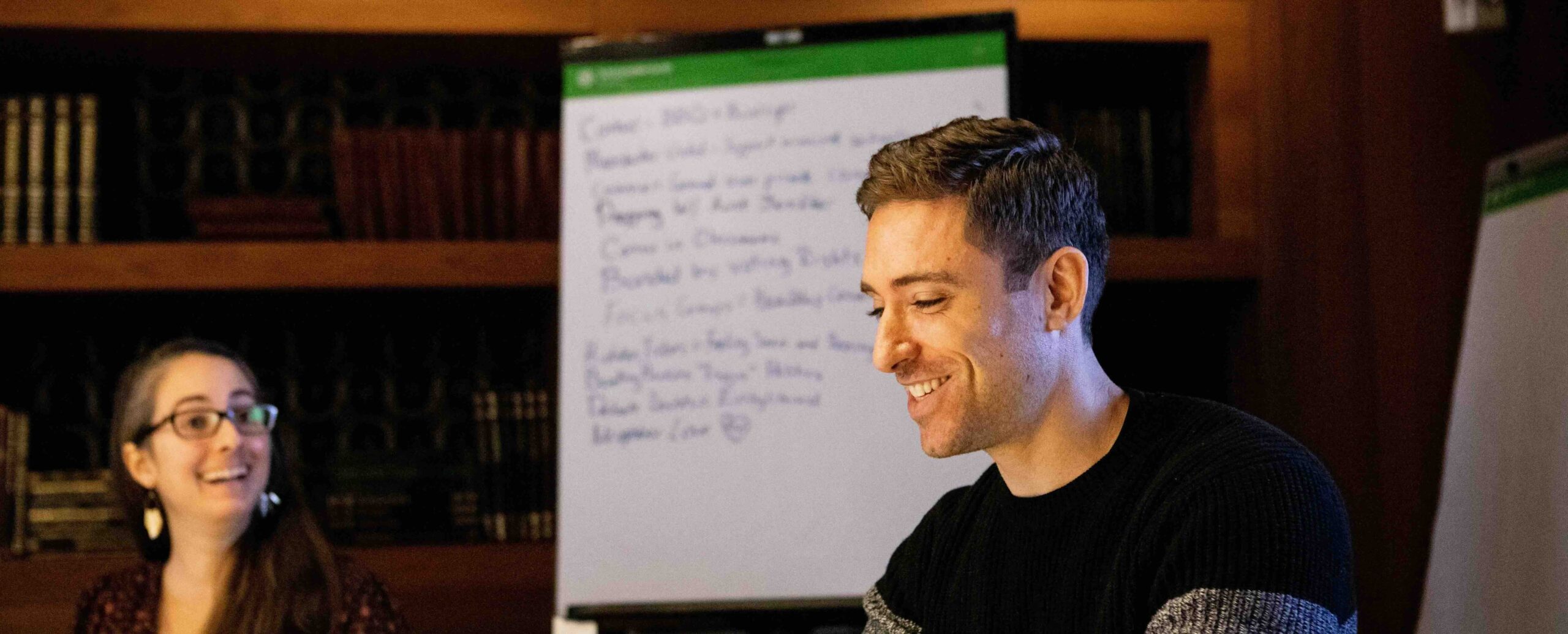
Two people are smiling and talking at a table in a library, with a flipchart in the background.

Consulting

Supporting Partners with Research and Strategy

Americans in Conversation Proprietary Tool – Americans in Conversation (AIC) is our large-scale qualitative research panel. AIC allows us to go beyond traditional surveys by capturing how people express their views in their own words, at scale. This enables us to understand the language, narratives, and emotions behind opinions; test ideas and messages with real people in real time; and bridge the gap between qualitative depth and quantitative scale. We integrate AIC across our work—from message testing to survey design—giving our partners deeper, more actionable insights. 

Our Approach

We employ methods and capabilities that drive real insight and impact: 

Public Opinion Research

We design and conduct research to understand attitudes, beliefs, and behaviors across nationally representative samples and more niche populations. 

  • Large-scale surveys and polling  
  • Experimental methods (e.g., randomized controlled trials (RCTs), conjoint analysis) 
  • Focus groups, interviews, qualitative panels 
  • Mixed-methods research projects 
  • Perception gaps research  
Examples:

Immediately following the 2024 election, More in Common asked 5,005 Americans, representative of the country, questions to better understand what shaped their voting decisions, their views on polarization-related issues – and most importantly, if they accurately understood one another. 
As a nonpartisan nonprofit, More in Common’s motivations for studying the 2024 election were:

  • To capture how values and worldviews shape Americans’ political beliefs and relate to division.
  • To measure misperceptions between groups and explore how they explain decisions.
  • To identify underappreciated commonalities – and opportunities – that allow us to build on common ground and
    strengthen American democracy.

Our post-election analysis suggests that misperceptions played a key role in voter behavior.
Environmental policy is often framed, like many issues in our public discourse, as a battleground of “left vs. right.” The national narrative often casts progressives as climate alarmists and conservatives as climate deniers. With these competing narrow framings, over eight in ten Americans are understandably frustrated with the partisan nature of environmental discourse.

Our latest research finds that Americans agree on more than they think when it comes to environmental policies. Large majorities across party lines support protecting public lands, addressing pollution, and leading the world in clean energy development. Yet most Americans underestimate how widely these views are shared, both within their own party and across the aisle. ​

Sports fandom is a powerful source of meaning and identity for millions of Americans. Fans are more trusting and more confident in America’s core institutions than non-fans. Fandom benefits the individual fan as well: fans are less lonely, more active, and more connected to their families than non-fans.

More in Common conducted a study to better understand how these benefits may extend into the democratic sphere. Being embedded in one’s community is foundational to civic participation, social trust, and, ultimately, democratic health. This kind of connection is especially critical today, as political polarization continues to fracture society, loneliness remains on the rise, and emerging technologies like AI threaten to further isolate us. Stated more simply: in a country as big and diverse as ours, doing stuff together is really important, and it’s more difficult than ever to do.

But entry points to civic participation matter. Through its research over the last seven years, More in Common has consistently found that Americans’ whose most important identity is a political one, and who are in turn most politically active, tend to feel the most hostility towards their opposing political party members.

Sports fandom may offer a uniquely durable and scalable entry point to civic participation.

Message Testing & Strategy

We work alongside partners to help design, shape, and evaluate programs focused on addressing polarization and building We help organizations develop and refine messaging that resonates with their audiences. 

  • Rigorous message testing (quantitative and qualitative)  
  • Values-based messaging frameworks  
  • Narrative development and strategy  
Examples:

We live in a moment marked by political conflict, institutional strain, and deep mistrust. Many Americans perceive democratic norms to be under pressure and social divisions as widening. Assuming unity seems quaint, even naive. Could there be any hope that Americans still agree on the language of civic life, like “democracy” and “freedom”?  

To find out, More in Common partnered with Philanthropy for Active Civic Engagement (PACE) to field the 2025 Civic Language Perceptions Project (previously conducted in 2021 and 2023). We surveyed more than 5,000 US registered voters nationwide to understand how Americans perceive civic terms, and how they use words to describe democracy and the threats to it. 

Drawing from multiple message tests on American identity, this guide equips institutions and civil society leaders with strategic messaging that can disrupt divisive narratives and reach key audiences with more inclusive narrative of American identity.

Segmentation Analysis

We identify distinct audience groups and provide tools to engage them effectively. 

  • Audience segmentation 
  • Deep dives into segment-specific attitudes and motivations  
  • Replicable methods to generate segmentation results in future work 
  • Practical guidance for applying segmentations  
Examples:

In 2018, More in Common launched “Hidden Tribes,” a research study aimed to understand the forces that drive political polarization and tribalism in the United States. Through collecting the views of 8,000 Americans we found people’s worldviews, core beliefs, and attitudes can predict an individual’s views on social and political issues with greater accuracy than demographic factors like race, gender, or income.
The research revealed 7 unique “tribes,” Americans fall into based on their underlying beliefs and attitudes. Within these 7 tribes, we found 4, comprising 67% of Americans, are part of the “Exhausted Majority,” defined by Americans that despite different views on policies, are fed up with polarization, believe we have more in common than what divides us, are more ideologically flexible, and want to move past our differences.

Yet they also are not as politically active as the “wings,” which are the tribes defined by those on the right and left who often dominate the political conversations, are more ideologically rigid, and have greater distrust and animosity of the opposing side.

Our Hidden Tribes report has illuminated the polarization landscape for leaders, media, politicians, and the public. 

There is an image at the heart of American politics: a sea of red-hat-wearing MAGA supporters at a Trump campaign rally, representing the millions of Americans who voted for him over the past three elections — 63 million in 2016, 74 million in 2020, and 77 million in 2024. Yet this image is misleading. President Trump has built a coalition, not a cult. This coalition shares many common concerns, from unregulated immigration to progressive overreach to American decline. But it also contains groups with distinct identities, competing priorities, and clashing worldviews. And while there is a strong core of ardent Trump supporters whose identity is wrapped up in the MAGA movement, they represent a minority: only 38 percent of Trump voters say that being MAGA is important to them.

Drawing on surveys, interviews and group conversations conducted with over 10,000 Trump voters over 10 months concluding in early 2026, this study finds four distinct types of Trump voters: MAGA Hardliners, Anti-Woke Conservatives, Mainline Republicans, and the Reluctant Right.

Survey Design & Pre-Testing 

We support partners in designing effective research instruments. 

  • Survey design and questionnaire development  
  • Survey pre-testing  
  • Language refinement grounded in real audience perspectives  
Examples:

More in Common, in partnership with the American Press Institute, sought to find out what Americans want to read or watch in the media. Our findings suggest Americans want a balance of positive and negative stories and have a desire to see more solutions-oriented reporting. Americans also view national media as more helpful for understanding others who are different from them and see local media as more helpful for learning about issues that impact people’s everyday lives.

Qualitative Research & Social Listening 

We capture how people think, feel, and talk about issues in their own words. 

  • Focus groups and in-depth interviews  
  • Social listening and narrative analysis  
  • Story-driven qualitative research  
Examples:

Since 2022, More in Common has been working with StoryCorps’ One Small Step program to examine how Americans react to conversations between two Americans with different beliefs and worldviews.

Our Americans in Conversation (AIC) online research platform, (similar to large online focus group) consists of a politically and demographically diverse online community of 100-300 Americans with whom we can engage with continuously over time. Through this platform we regularly engage with participants—asking questions, testing ideas, and refining messaging guidance in response to real-time events. We’ve found that qualitative data is a powerful and underused way to both understand and present the views of Americans. We work with partners to design questions and activities to generate quick insights and get a pulse on what Americans are thinking and to get a deeper understanding of their underlying beliefs.

Monitoring, Evaluation & Learning

We help organizations measure impact and improve their work over time. 

  • Program design and evaluation  
  • Outcome measurement frameworks  
  • Learning agendas and adaptive strategy  
Examples:

Since 2022, More in Common has been working with StoryCorps’ One Small Step program to examine how Americans react to conversations between two Americans with different beliefs and worldviews.

Thought Partnership & Field Building  

We work alongside partners to shape strategy and strengthen the broader field. 

  • Strategic advising and collaboration  
  • Convenings and workshops  
  • Partnerships with academic institutions  

Custom Solutions

We work with partners to develop a custom research, communications, or strategy solution.

Examples:

Since 2022, More in Common has been working with StoryCorps’ One Small Step program to examine how Americans react to conversations between two Americans with different beliefs and worldviews.

More in Common, in partnership with the American Press Institute, sought to find out what Americans want to read or watch in the media. Our findings suggest Americans want a balance of positive and negative stories and have a desire to see more solutions-oriented reporting. Americans also view national media as more helpful for understanding others who are different from them and see local media as more helpful for learning about issues that impact people’s everyday lives.

I have been following More in Common’s research for many years. To actually have More in Common evaluate and study our work was a dream come true- it has informed every aspect of the creation and execution of One Small Step.

Dave Isay
StoryCorps

More in Common uses tools and frameworks that can help us all — including members of the press — better understand and serve the American public. Our network of news leaders has benefitted from their survey findings and psychological insights as they work to reimagine news’ role in facilitating civic discourse.”

Kevin Loker
Director of Strategic Partnerships & Research at the American Press Institute

Our mission is to bring communities together across divides to help welcome newcomers and ensure they thrive–and in doing so, rebuild our collective identity and commitment to welcoming, so that as a nation we can welcome many more. More in Common’s insights about how best to bring people from across our American tapestry into welcoming work has been essential to achieving this goal–and we are so inspired by how many Americans are participating.

Nazanin Ash
Chief Executive Officer, Welcome US

We partner with leading organizations across sectors to deliver research that drives real-world impact.

Get in Touch

Interested in working with More in Common to support messaging, convening or custom solutions support? We’d love to explore how we can support your work. Complete the form below to connect with us.