Pluralism, Social Connection
27 August 2025
How Fandom Connects Americans to the People Around Them
September 8, 2026
Current Events
Social Connection
For many Americans, sports is one of the few places where people from all walks of life reliably come together. From tailgating at a football game to filling out a March Madness bracket in the office, fandom is a shared cultural ritual, often inherited from family, carried between cities, and picked back up with friends every season.
At the same time, life in the United States feels increasingly fractured. Political institutions are viewed with skepticism, partisan divides feel stronger than ever, and loneliness continues to rise. In a country this large and diverse, connecting with our communities matters a great deal, but it has rarely been harder to do.
This report, produced in partnership with FOX Sports, examines the relationship between sports fandom and community belonging, and asks where the connections that come with fandom most often happen. We surveyed 5,572 US adults from May 28-June 11, 2026 and paired that data with a qualitative panel of 210 Americans who answered open-ended questions about sports in their own words. This report traces fandom outward from the individual, to the people around them, and to the communities and social networks that sports touches.
This research builds on our August 2025 report, Fans, Politics, and the Power of Sports, which explored the impact of sports fandom on civic life and social connection. That research found that sports fandom takes the edge off political engagement, allows men to express themselves and connect, and is connected to greater support for democratic norms and values.
To classify fandom, this study again uses the framework Ben Valenta and David Sikorjak introduced in their seminal 2022 book Fans Have More Friends. The report sorts respondents into Non-Fans, who do not follow sports at all, and Low Value, Mid Value, and High Value fans, with High Value fans following sports most closely and passionately.
Here are our key findings.
As partisan divides deepen, Americans have fewer and fewer places where they are simply around people who vote differently from themselves. Sports is a rare refuge to build bridges across these differences.
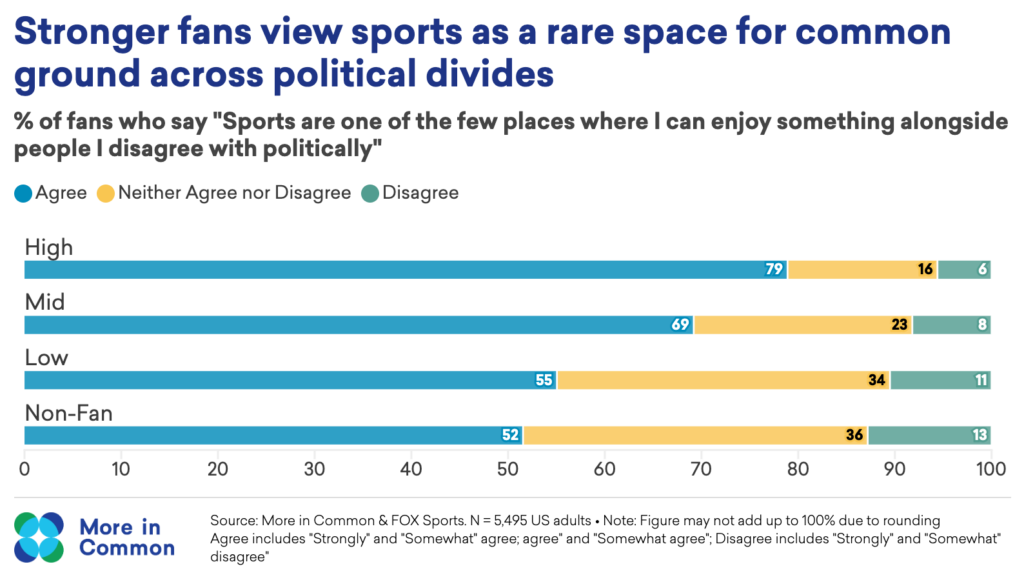
Openness to connection across difference grows alongside fandom. The most avid fans are the most likely to see sports as a place where people on opposite sides can still share something enjoyable.
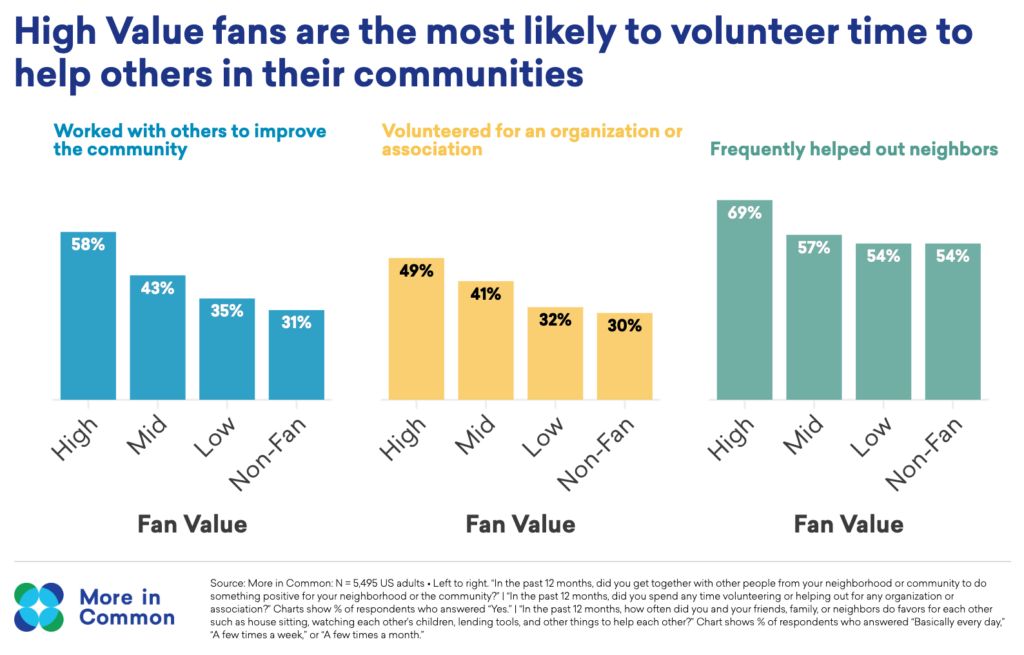
Across our data, deeper fandom corresponds with a greater presence in community life. Stronger fans tend to feel more connected to the places they live and more inclined to contribute to them.
The pattern holds across belonging, trust, neighborhood connection, and volunteering. The fans most invested in the game tend also to be the ones most invested in the community around them.
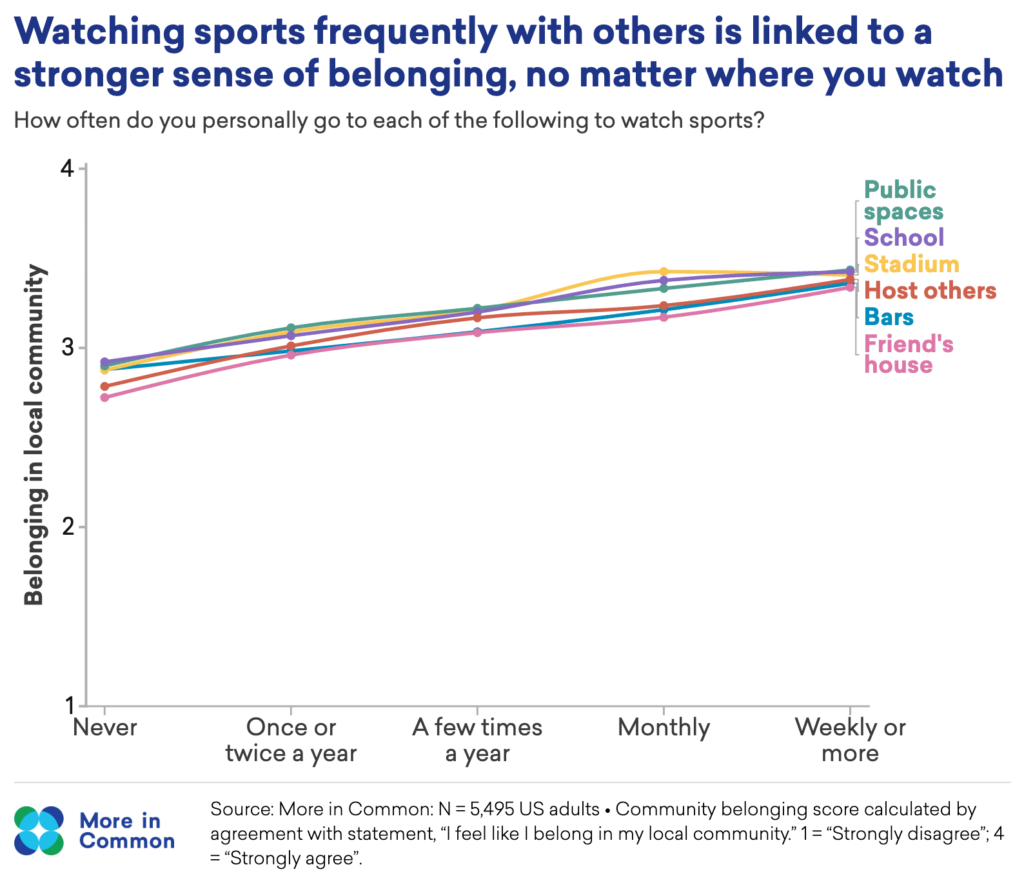
Watching sports with others frequently is linked to a stronger sense of belonging, no matter where people watch—bars, stadiums, a friend’s house, or public spaces—and regardless of how big a fan they are.
More in Common conducted this survey research in partnership with FOX Sports from May 28 – June 11, 2026.
Nationally representative survey sample
N = 5,572 US adults
• Weighted on age and gender (interlocked), education, race/ ethnicity, Census region, and 2024 presidential vote and turnout.
• The margin of error is +/- 1.50% for the US average and higher for subgroups.
• Conducted online by More in Common using a participant panel from Rep Data.
• Numbers in data visualizations are rounded to the nearest whole number. Figures may total to larger or smaller than one-hundred percent due to rounding.
From March 11 – 16, 2026, More in Common surveyed 210 respondents from its qualitative research panel “Americans in Conversation.”
Respondents were broadly representative of the American population. Panelists were asked open-ended questions about their
thoughts on sports and sports fandom. Quotations from those respondents are included in this report. Where provided, names have been changed to protect their privacy. Grammar and punctuation may have been lightly edited for clarity.
of High Value fans see sports as a place to enjoy something alongside people they disagree with politically, compared with 52% of Non-Fans.
of High Value fans feel they belong in their local community, compared with 74% of Non-Fans.
of High Value fans use sports to start a conversation with someone new, compared with 13% of Non-Fans.
Explore the depth of our research at your fingertips. Get the complete insights by downloading the full report today.
What unites and divides Americans today? This newsletter takes a closer look at issues pressing on America’s social and political fabric and provides recommendations for how to strengthen ties to keep us bound together.