Pluralism, Narrative & Communications, Social Connection, Trust
27 June 2025
February 20, 2026
Pluralism
Current Events
Narrative & Communications
American Identity
We live in a moment marked by political conflict, institutional strain, and deep mistrust. Many Americans perceive democratic norms to be under pressure and social divisions as widening. Assuming unity seems quaint, even naive. Could there be any hope that Americans still agree on the language of civic life, like “democracy” and “freedom”?
To find out, More in Common partnered with Philanthropy for Active Civic Engagement (PACE) to field the 2025 Civic Language Perceptions Project (previously conducted in 2021 and 2023). We surveyed more than 5,000 US registered voters nationwide to understand how Americans perceive civic terms, and how they use words to describe democracy and the threats to it.
Despite the political conflict of the moment, we found surprising common ground. Here are five key insights.
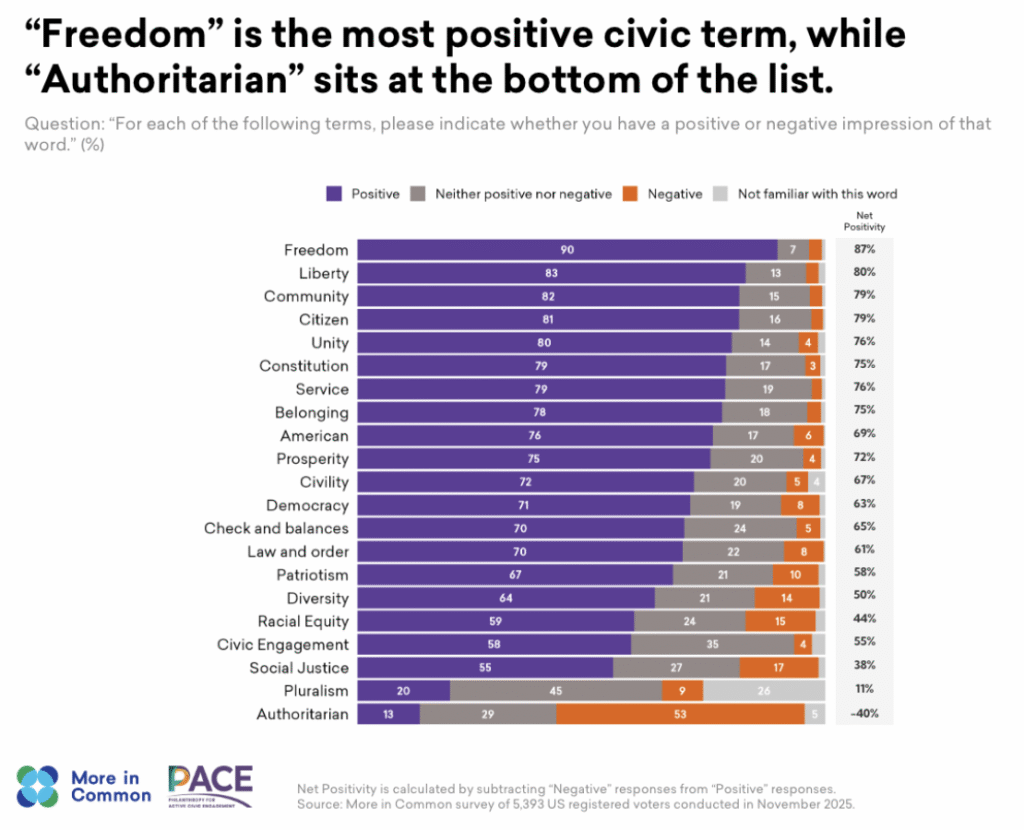
We asked Americans whether they have a positive or negative impression of various civic language. Our data reveals that core civic terms continue to command broad support. For example, “Freedom” (+87% net positive), “Liberty” (+80%), and “Community” (+79%) sit at the top of the list. “Democracy” still receives a strong net positive rating (+63%), despite ongoing debates about its current standing.
Terms that are often perceived as ideologically-coded, such as “Social Justice” (+38%), “Diversity” (+50%), and “Patriotism” (+58%), are still net positive overall. Majorities of Democrats, Republicans, and Independents each express favorable impressions of these terms.
In contrast, “Authoritarianism” receives a strongly negative net rating (–40%), placing it at the bottom of the list.
The pattern is clear: Americans do not reject civic language. They continue to respond positively to it.
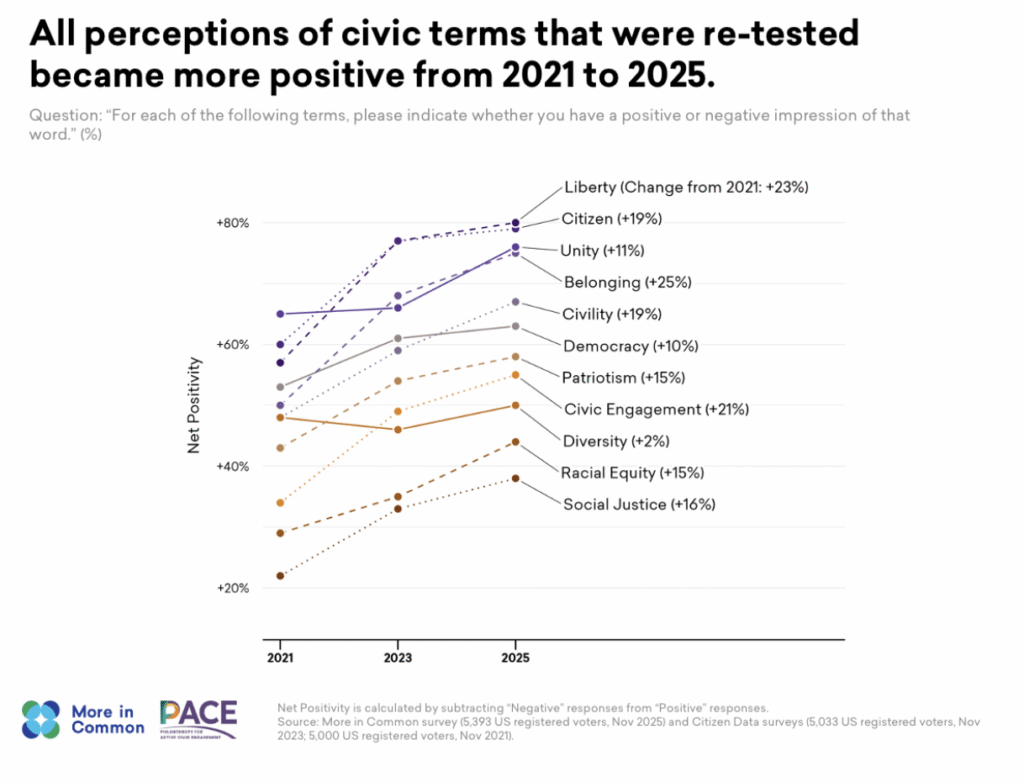
PACE’s Civic Language Perceptions Project has been conducted in 2021, 2023, and 2025. Every term retested from 2021 became more positively perceived in 2025.
The largest increases occurred for the terms “Belonging” (+25% change in net positivity since 2021), “Liberty” (+23%), and “Civic Engagement” (+21%). Even terms tied to ongoing political debates, such as “Democracy” (+10%), “Patriotism” (+15%), and “Racial Equity” (+15%), saw gains from 2021 to 2025.
At a time when many describe civic life as under attack, perceptions of civic language have grown more positive. One possible interpretation is that heightened conflict can make civic ideals feel more salient—reminding Americans what they want to protect, not just what they endorse.
Net positivity alone does not tell the full story. To assess which words unite Americans across lines of difference, we constructed an updated “Bridgeyness” index that incorporates net positivity, whether respondents say a word brings people together, and how much perceptions vary across political affiliation, generation, gender, and other sociodemographics.
“Community” ranks highest on our Bridgeyness scale, followed closely by “Freedom,” “Unity,” and “Service.” It is not surprising that “Community” performs well on an index that captures unity, because its meaning is explicitly rooted in connection and belonging. What is more striking is that “Freedom” performs almost equally well. Unlike “Community,” freedom is often framed in individual terms and is frequently contested in political debate.
Their virtual tie suggests something important: Americans do not experience connection and freedom as opposites. Instead, both “Community” and “Freedom” may be something core to the American identity—values that resonate across groups even in polarized times.
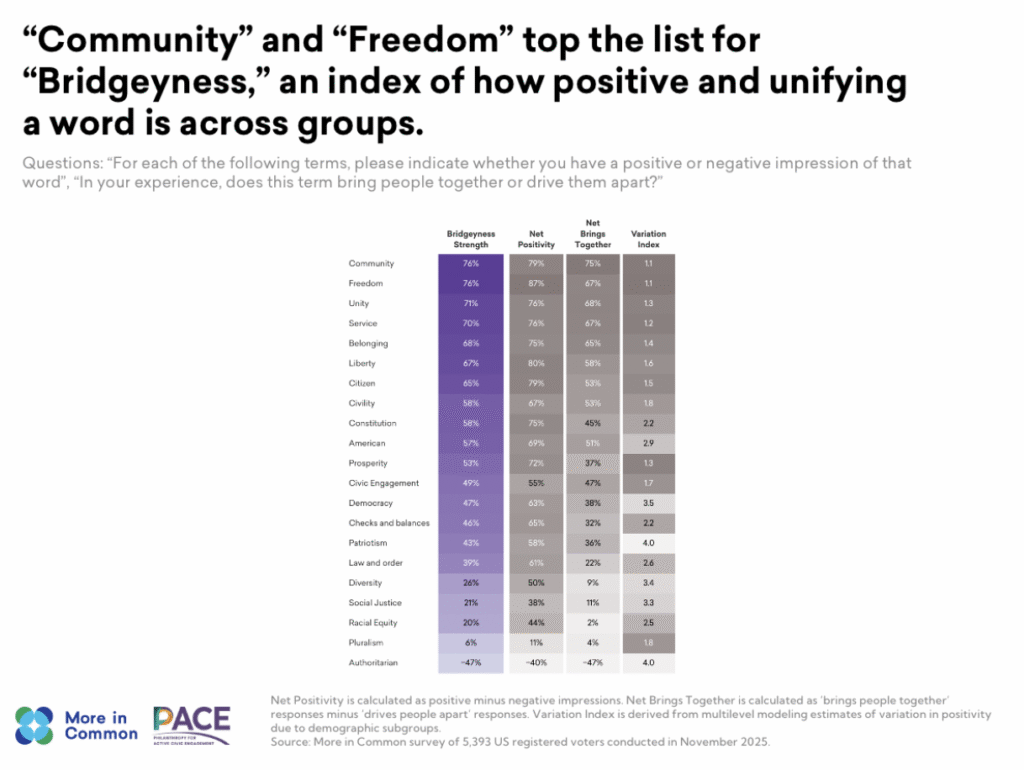
At first glance, the negative net rating for “Authoritarianism” (–40%) suggests a broad rejection of the term. But while 53% view the term negatively, 29% report feeling neither positive nor negative toward it. That sizable neutral group required further analysis.
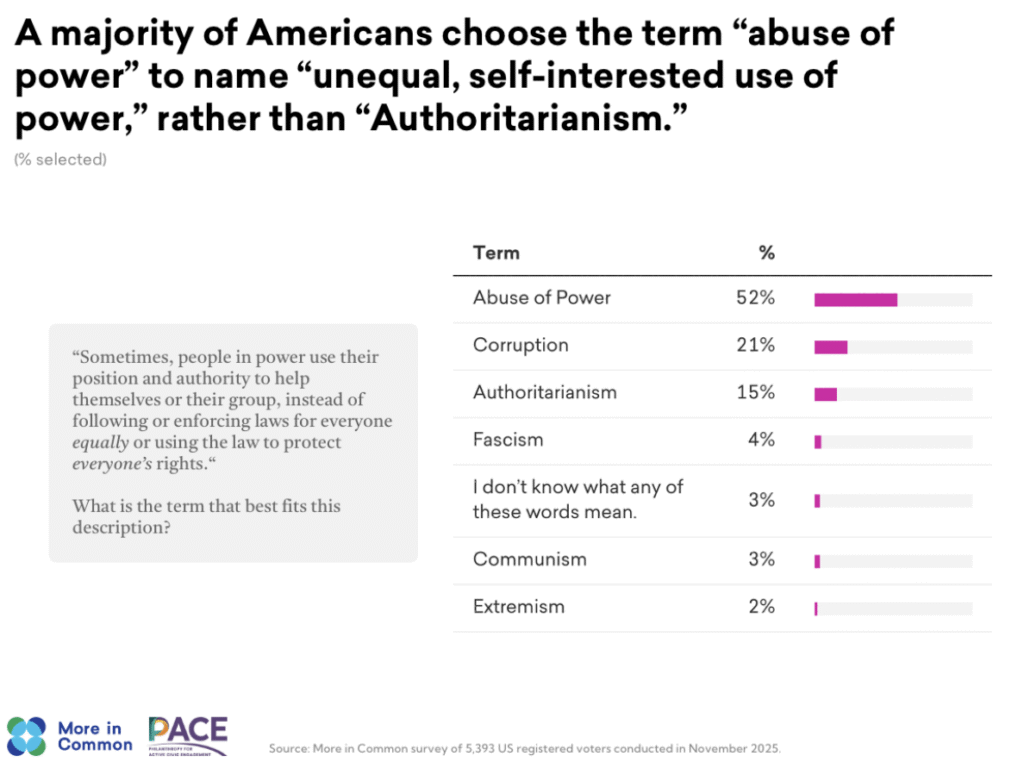
To test this more directly, we presented respondents with a definition of authoritarianism drawn from political psychology: “Sometimes, people in power use their position and authority to help themselves or their group, instead of following or enforcing laws for everyone equally or using the law to protect everyone’s rights.” We then asked which label best fits that description.
Surprisingly, only 15% of respondents choose “authoritarianism”, even though the definition describes authoritarianism. Instead, the majority selected “abuse of power” (52%), followed by “corruption” (21%) to best represent that definition.
What might this mean? When people encounter authoritarian behavior, they reach for more concrete, everyday terms that describe what’s actually happening: someone misusing their position or breaking the rules for personal gain. For communicators concerned with democratic accountability, this suggests a clear path forward: describe the specific behavior rather than invoking abstract terminology. “Abuse of power” and “corruption” connect immediately because they name actions people can picture and evaluate.
In conversations with partners across civil society and democracy-focused spaces, we are asked a common question: how is “democracy” perceived by Americans today?
The baseline remains strong. “Democracy” carries a +63% net positive rating, and only 8% of Americans view it negatively. Whatever concerns people may have about the current state of American democracy, the term itself retains broad goodwill. But we wanted to go further. Is “democracy” the strongest available frame?
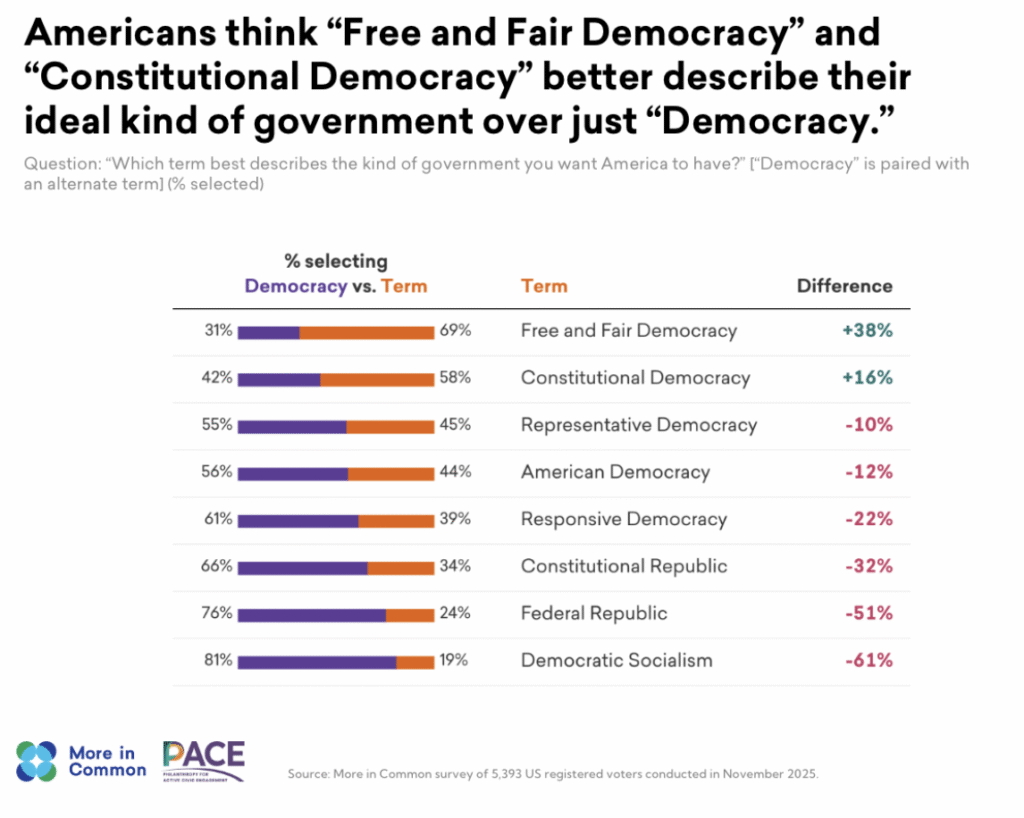
When asked which term best describes the kind of government they want America to have, Americans showed clear preferences. Only two alternatives outperformed “Democracy” on their own: “Free and Fair Democracy” (+38% relative to “Democracy”) and “Constitutional Democracy” (+16%). All other terms—including “Representative Democracy,” “Constitutional Republic,” and “Democratic Socialism”—performed worse than “Democracy.”
The pattern connects with the earlier finding: “Freedom” was the highest net positive term in the study (+87%). When Americans think about their ideal system, freedom and fairness are central to how democracy is understood and desired. The preference for “Constitutional Democracy” adds another layer, invoking founding principles and a sense of continuity with the nation’s foundational commitments.
This is how Americans describe the democracy they want: one defined by liberty, fairness, and enduring constitutional values.
What does this all mean?
Experts have rightfully sounded the alarm on increasingly fractured information environments and diverging realities. But we find that across party, generation, and other sociodemographic categories, Americans remain united in their positive interpretation of core civic terms: freedom, fairness, community, and even democracy itself.
This does not mean there are no real disagreements about policy, institutions, or rights. Nor does it represent consensus about the current state of American democracy. But it does reveal something important: Americans continue to share a common civic vocabulary.
That matters. Shared language creates the conditions for persuasion, coalition-building, and collective action—even amid deep disagreement. We are not yet speaking past each other entirely.
For communicators, civic leaders, and practitioners, the lesson is practical: start with the language people already trust. Terms that score highly on net positivity and “bridgeyness”—like freedom, fairness, and free and fair democracy—are the words Americans across divides already use to describe what they want. In a moment defined by political division, these words create a foundation to navigate conflict.
in their positive perceptions of core civic terms like “freedom,” “community,” and “democracy.”
is the most positive civic term
is broadly disliked, it is not the language Americans use to describe unequal or self-interested uses of power
Explore the depth of our research at your fingertips. Get the complete insights by downloading the full report today.
What unites and divides Americans today? This newsletter takes a closer look at issues pressing on America’s social and political fabric and provides recommendations for how to strengthen ties to keep us bound together.