Could Tucker Carlson lead the Reluctant Right and Gen Z away from Trump? ​

July 6, 2026

Topic

Current Events

American Identity

Tucker Carlson and Marjorie Taylor Greene made headlines after months of distancing themselves from the president, announcing they won’t be backing Republicans in this year’s midterms. The move has fueled speculation about cracks forming in Trump’s base. 

Carlson recently claimed that his departure represented a broader trend, stating that “If I’m out, then I think a lot of other people are out.” But do figures like Carlson have enough influence to pull support away from Trump? The answer is yes, quite possibly.

While Trump’s overall standing with his voter base remains solid, key vulnerabilities exist on the margins. Using the lens of our Beyond MAGA segmentation, we examine which factions within the Trump coalition are showing signs of departure and explore how that might relate to the conservative commentators who are most critical of Trump.

Here are the key insights.  

Key Takeaways

1. Trump’s overall support among his voter base remains intact and stable, despite slipping grades on the economy, immigration, and foreign policy.

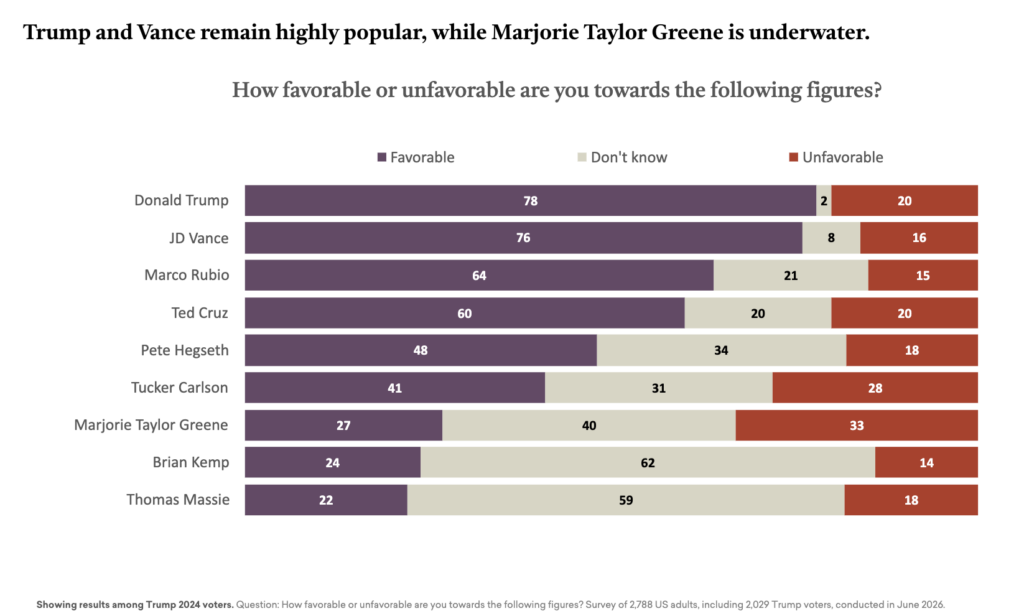
  • Trump remains the most favored figure in the Republican party at 78 percent, with JD Vance close behind at 76 percent. 
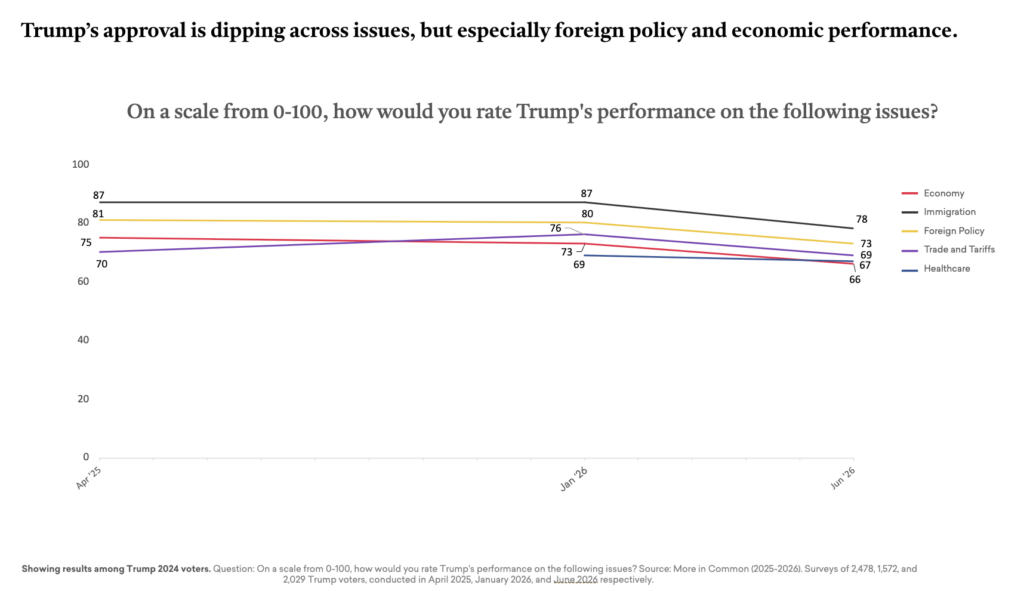
  • Trump’s grades are declining on key issues. Trump voters’ grades of the president, tracked from April 2025 to January 2026 to June 2026, are trending downward: 
    • Economy: 75 → 73 → 66 
    • Immigration: 87 → 87 → 78 
    • Foreign policy: 81 → 80 → 73 


2. The key groups Tucker Carlson could win over are souring on Trump and the MAGA movement. 

The Reluctant Right has both the lowest approval score of Trump of any segment and the steepest decline since our April poll, falling from 61 to 55.  

  • Only 11 percent say they still feel “very confident” in their vote, compared with 87 percent of MAGA Hardliners, 56 percent of Anti-Woke Conservatives, and 51 percent of Mainline Republicans. 
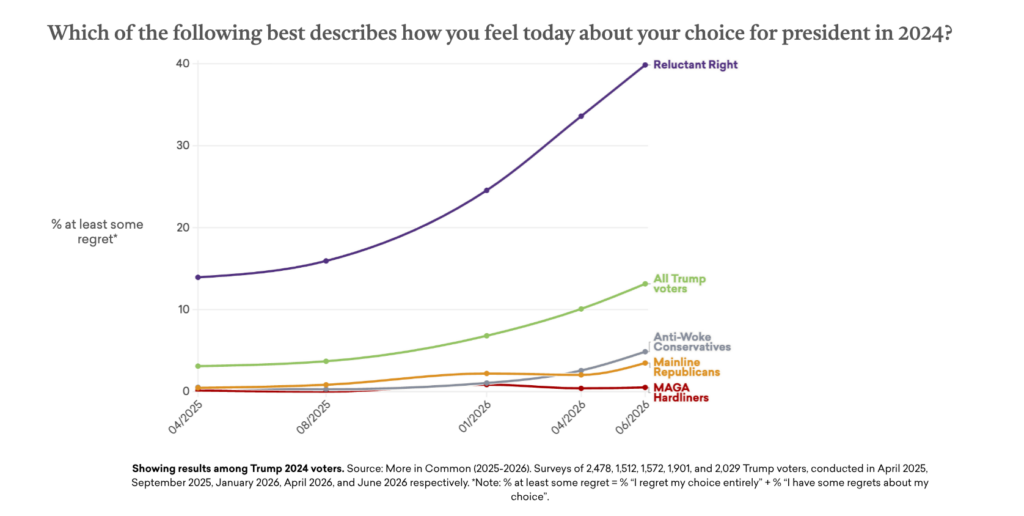
  • Forty percent express some level of regret, with 22 percent having “some regrets” and 18 percent regretting their choice “entirely,” versus essentially none of MAGA Hardliners and just 5 percent of Anti-Woke Conservatives.  
  • Three in four Reluctant Right Trump voters (74 percent) now say the MAGA movement is “dying out,” and four in five (80 percent) say Trump’s best days are “behind him.” 

“Everyday Americans care about living costs, healthcare, and job security, not Washington landmarks or brinkmanship. I feel like the administration is disconnected from the reality of regular families.” 

— Adrian, 43-year-old Hispanic man and Reluctant Right Trump voter from Ann Arbor, Michigan 

Along generational lines, Gen Z Trump voters reveal similar patterns of discontent. 

  • Gen Z Trump voters are the least confident in their 2024 vote of any age group, with only 31 percent saying they’re “very confident” in their choice, and the most likely to express some regret over it, at 22 percent. 
  • They are also considerably more skeptical of Trump’s character than older Trump voters: 54 percent say he’s engaged in more corruption in office than recent presidents, compared with 35 percent among Trump voters overall.
  • Nearly a quarter (24 percent) say he’s driven by personal gain, and 73 percent say his decisions are compromised by political and financial interests. 
  • That skepticism extends to their feelings about the MAGA movement: 
    • Forty percent of Gen Z Trump voters say MAGA is dying out, higher rates than among the Silent Generation (29 percent) and Baby Boomers (27 percent). 
    • Forty-one percent say Trump’s best days are behind him, compared with just 21 percent of the Silent Generation and 23 percent of Baby Boomers. 

“[Trump’s] handling of the Iran wars has changed how I saw him. It seems like he started a war when he previously didn’t, so his priorities seem to not be consistent [with] what I thought beforehand.”  

— Emil, 20-year-old White man and Reluctant Right Trump voter from Peshtigo, Wisconsin 


3. Conservative commentators can break with Trump, but it comes at a cost. 

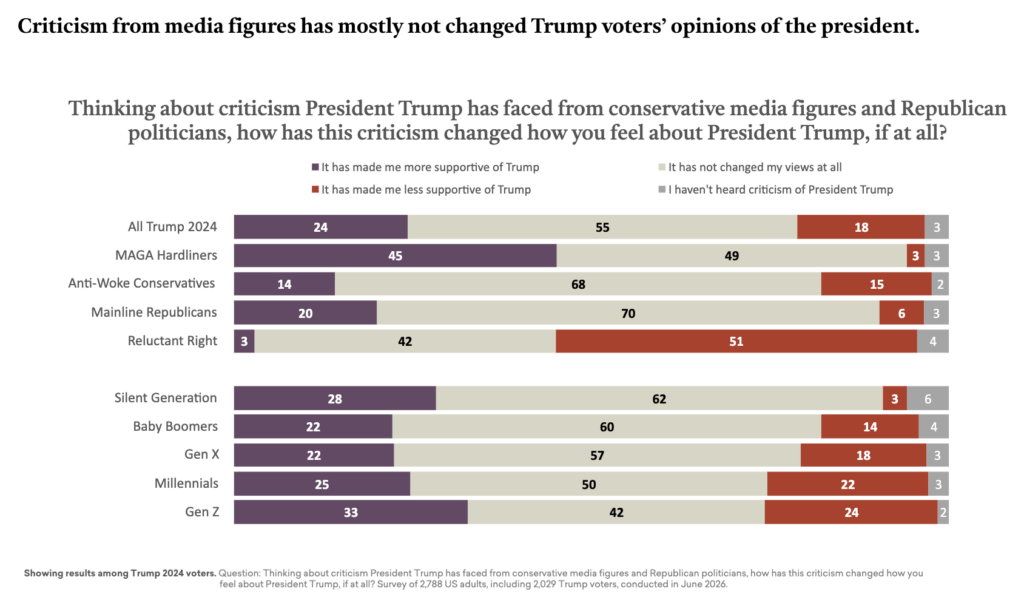
  • More than half of Trump voters (55 percent) say conservative commentator backlash has not changed their views at all.  
  • Twenty-four percent say the criticism has made them more supportive of Trump than less supportive (18 percent), a trend that holds true most among MAGA Hardliners and Anti-Woke Conservatives. 

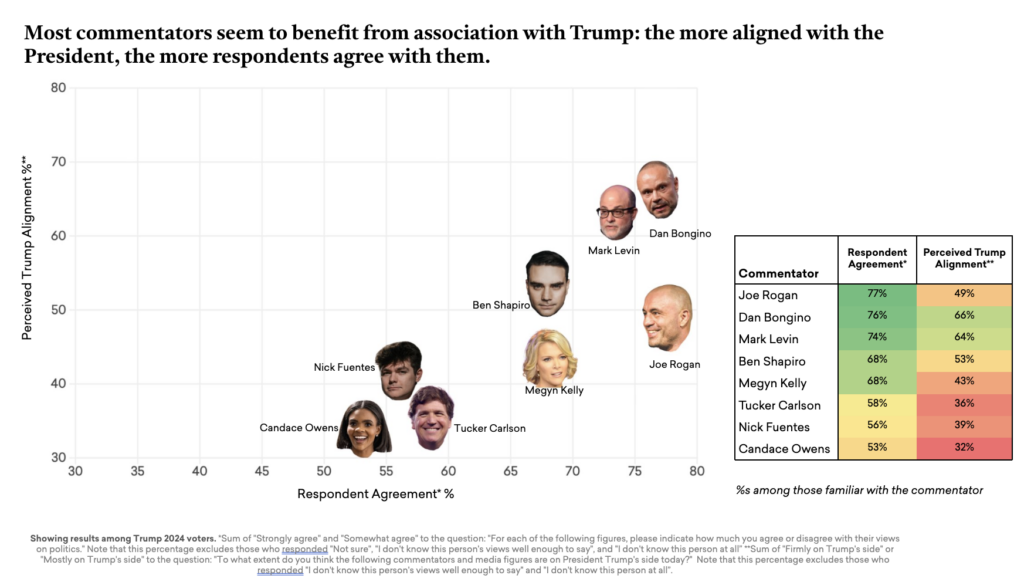
For most commentators, Trump voters’ agreement with their views tracks closely with how aligned they ‘re seen to be with Trump. 

  • Dan Bongino is highly trusted by his audience and seen as loyal to Trump. Sixty-six percent of Trump voters see him as aligned with Trump, and 76 percent agree with his views. 
  • Tucker Carlson and Candace Owens sit lower on both agreement and alignment. Only 36 percent of Trump voters see Carlson as aligned with Trump, and just 58 percent agree with his views. Owens scores even lower, at 32 percent alignment and 53 percent agreement. 
  • Joe Rogan is an exception. Despite only 49 percent of Trump voters seeing him as aligned with Trump, 77 percent agree with his views, the highest of any figure tested. Likely due to his apolitical show, his distance from Trump hasn’t cost him credibility with Trump voters. 

“I heard some on social media about some interventionist reps and commenters criticizing the war. Saying it costed a lot and resulted in endless Middle East entanglement instead of focusing on domestic priorities.” 

— Jonathan, 22-year-old Asian man and Reluctant Right Trump voter from Chicago, Illinois 


4. The Reluctant Right and Gen Z are a potentially receptive audience for Carlson’s criticism.

As the Reluctant Right and Gen Z Trump voters continue to sour on Trump’s handling of the economy and of foreign policy, they’re a ready audience for figures like Carlson. 

  • Fifty-one percent of the Reluctant Right say criticism of Trump from figures like Carlson has coincided with feeling less supportive of him, nearly three times the rate of Trump voters overall (18 percent). Similarly, 24 percent of Gen Z feel less supportive due to commentators’ critiques. 
  • Among the Reluctant Right, President Trump has the lowest favorability of any figure we tested in our study, while Tucker Carlson has the highest. Tucker Carlson has a 40% lead in net favorability (+10%) over President Trump (-30%). Among Gen Z, Trump remains more popular (+49%) than Carlson (+25%).
  • In recent months, Carlson’s audience appears to be trending younger. In November 2025, our data showed that Carlson’s audience and favorability was fairly evenly distributed across generations, if not skewed slightly older. Just over six months later, younger generations are warmer to him than older ones, even as he’s recognized as increasingly distant from Trump. 


5. For the Reluctant Right, frustrations with Trump may result in changes at the ballot box. But Gen Z is less ready to shift their vote. 

  • The Reluctant Right are the least likely of any Trump segment to vote in the midterms at all: 72 percent say they’ll definitely or probably vote in November 2026, trailing MAGA Hardliners (90 percent), Anti-Woke Conservatives (88 percent), and Mainline Republicans (80 percent)—though still above the US average (67 percent). 
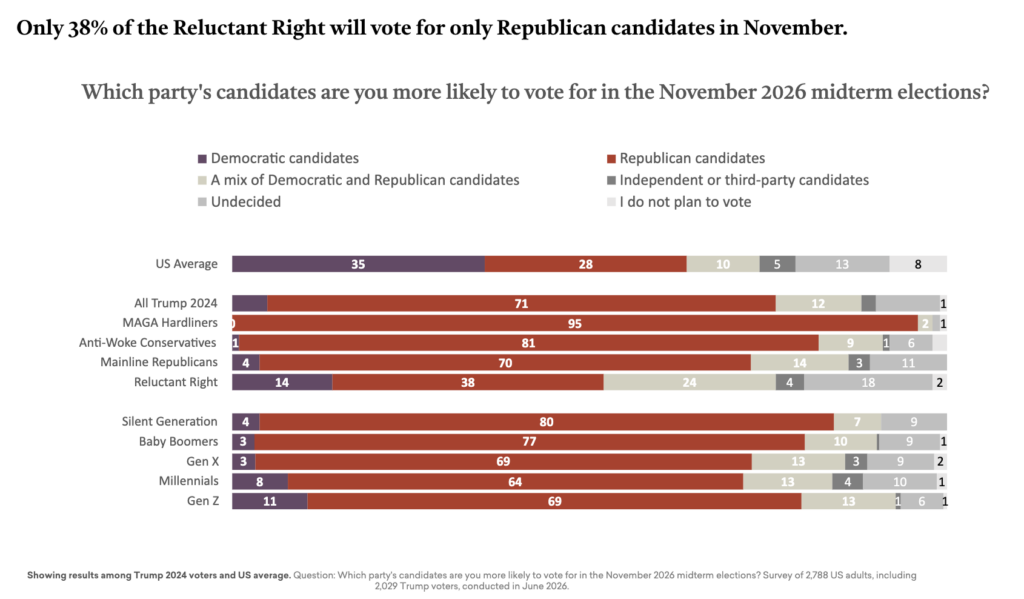
  • Only 38 percent of the Reluctant Right say they’ll vote only for Republican candidates, compared with 95 percent of MAGA Hardliners and 81 percent of Anti-Woke Conservatives.  
  • Nearly a quarter (24 percent) of the Reluctant Right plans to split their ticket between Democrats and Republicans, while 14 percent are leaning Democratic outright, and another 18 percent remain undecided. 
  • Meanwhile, 69 percent of Gen Z Trump voters say they’ll vote only for Republicans in the midterms, essentially in line with the broader Trump 2024 coalition (71 percent) and higher than Millennials (64 percent). Their doubts have not translated to changes in how they plan to vote.   

Polling Firm: More in Common 

Sample Size (US): N = 3,151 U.S. adults, including 2,459 2024 Trump voters

Fieldwork Dates: June 10-17, 2026

Margin of Error: The nationally representative sample was weighted to be representative of the U.S. population on gender and age (interlocked), race, education level, region, and 2024 presidential vote and turnout, based on the 2020 U.S. Census and the 2023 American Community Survey. The Trump voter sample was weighted on gender and age (interlocked), race, education level, and region. The weighting targets are based on the 2024 Edison Research Exit Poll. ​

The margin of error (adjusted for weighting) is ±2 percentage points for the national sample and ±2 percentage points for the 2024 Trump voter sample. The margin of error is higher for subgroups.​

Numbers in data visualizations are rounded to the nearest whole number. Figures may total to larger or smaller than one-hundred percent due to rounding.

From June 12-18, 2026, More in Common surveyed 233 respondents from its qualitative research panel “Americans in Conversation” about their attitudes toward President Trump,  current events, conservative commentators, corruption, and midterm vote intention.

55%

of Trump voters say conservative commentator backlash has not changed their views at all and 24 percent say the criticism has made them more supportive of Trump.

38%

of the Reluctant Right plans to vote only for Republicans candidates in the November 2026 midterm election.

+40%

The advantage in net favorability that Tucker Carlson (+10%) has over President Trump (-30%) among the Reluctant Right.

Related Reports

Current Events, American Identity
20 January 2026

Beyond MAGA: A Profile of the Trump Coalition

Current Events, Foreign Policy, Perception Gaps

16 April 2026

The War in Iran & the Shifting Trump Coalition

Download Full Report

Explore the depth of our research at your fingertips. Get the complete insights by downloading the full report today.

Sign Up for Our Newsletter

What unites and divides Americans today? This newsletter takes a closer look at issues pressing on America’s social and political fabric and provides recommendations for how to strengthen ties to keep us bound together.