Current Events, American Identity
20 January 2026
April 16, 2026
Current Events
Foreign Policy
Perception Gaps
In the 2024 presidential election, President Trump won the popular vote by expanding his coalition in unprecedented ways. More moderates, independents, Hispanics, Black Americans, young Americans, and voters in blue states supported him than any other Republican presidential candidate this century. Much of this support was gained by persuading voters that he shared their priorities. Eighteen months later, some of these dynamics appear to be shifting.
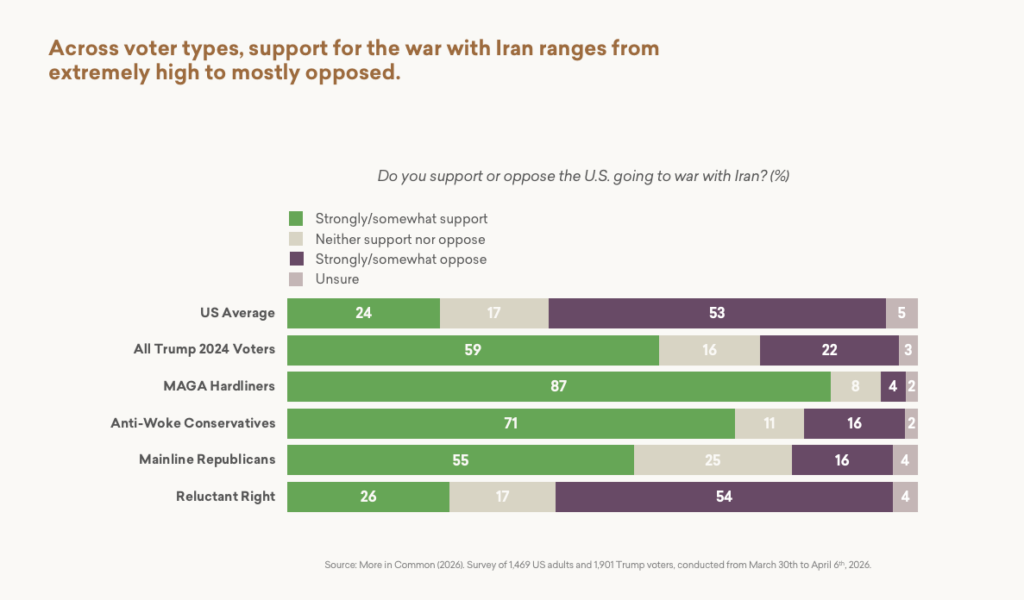
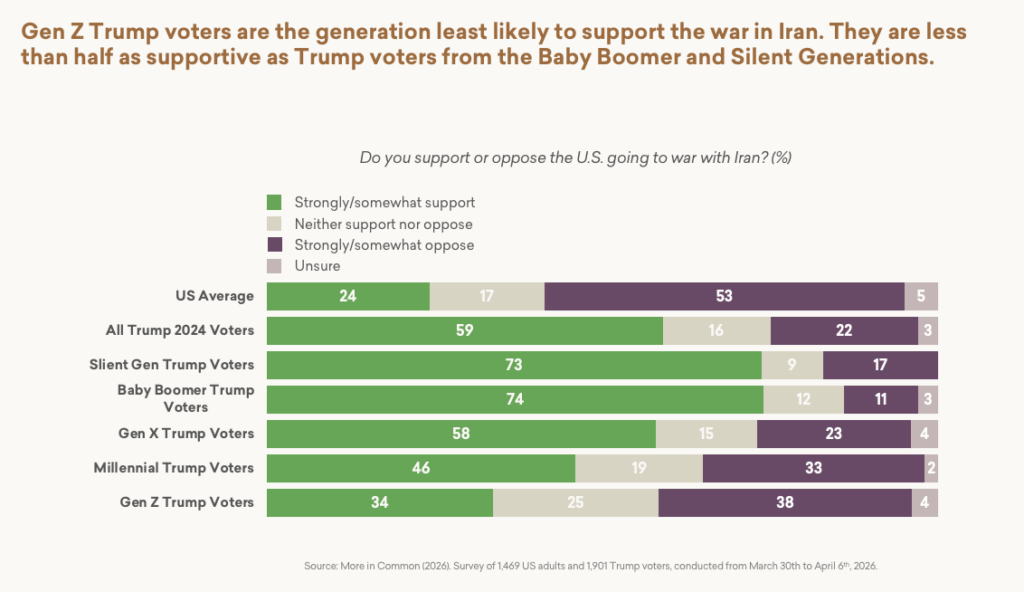
The president’s decision to engage in a war with Iran has been controversial. Our most recent survey, conducted from March 30 to April 6 among a nationally representative sample of 1,469 US adults and 1,901 2024 Trump voters, finds that just 25 percent of Americans support the war while 52 percent are opposed.
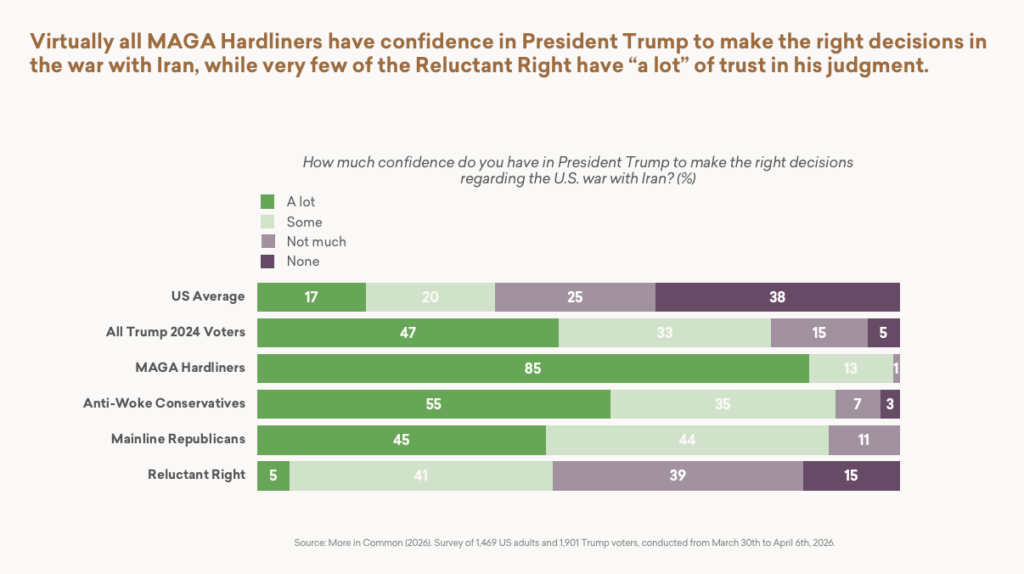
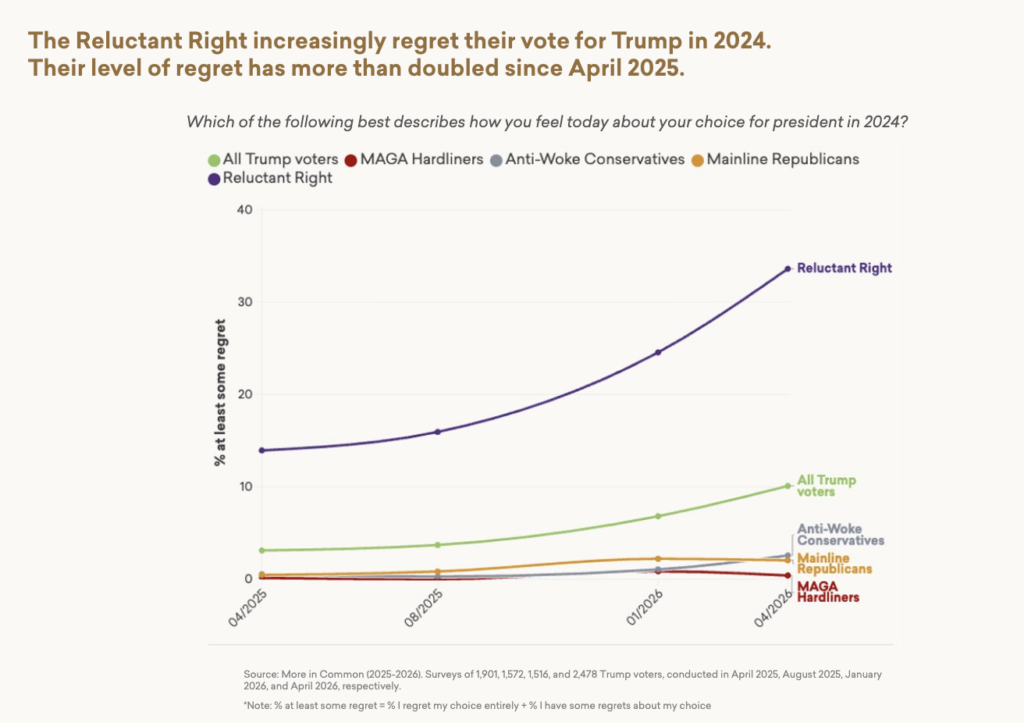
Recent headlines have focused on critics within the conservative media landscape, pointing to elite voices like Tucker Carlson and Megyn Kelly who have publicly broken with the president over the war. Yet this opposition risks being overstated: six in ten of the president’s voters are supportive of the war, his overall approval rating has dipped only modestly, and few Trump voters regret voting for him, with the notable exception of the Reluctant Right.
In this analysis, we use the lens of More in Common’s Beyond MAGA segmentation to examine how the members of the President’s coalition—with their distinct viewpoints, priorities, and breaking points—are responding to the war. We explore where the coalition is holding and where early signs of strain are beginning to emerge.
Here are our key findings.
“If this action is what it takes to help this country thrive and survive, I’m for it. This will also help to ensure our country’s safety against Iran’s regime.”
– Alexa, 47-year-old White woman and MAGA Hardliner from Thibodaux, Louisiana
“While I don’t like that it seems to always be our country that has to be involved in other countries’ relations, I think it was almost necessary in this case. It was a dangerous, evil regime that was killing their own citizens and chanting ‘death to America’ while also threatening the life of our president. It does not make me think of any particular example though.”
– Ella, 33-year-old Mixed race woman and Anti-Woke Conservative Trump voter from Mansfield, Massachusetts
“I am one social security check from having my lights out. I can’t afford gas going up like my grocery bill.“
– Amy, 63-year-old White woman and Reluctant Right Trump voter from Walker, Louisiana
“I think it is a pointless war for the United States to be involved in; It will just waste taxpayer dollars. Yes, bad people will be killed in Iran, but America has other problems other than bad people in Iran. This feels like a lot of wars that happen in the Middle East; kill a leader, war starts, war goes on forever, more debt and millions of soldiers sadly lost without a clear goal.”
– Liam, 20-year-old White man and Reluctant Right Trump voter from Peshtigo, Wisconsin
Polling Firm: More in Common
Sample Size (US): N = 1,469 U.S. adults and an oversample of 1,901 2024 Trump voters
Fieldwork Dates: March 30th to April 6th, 2026
Margin of Error: The margin of error (adjusted for weighting) is ±2.55 percentage points for the national sample and ±2.24 percentage points for the 2024 Trump voter sample. The margin of error is higher for subgroups.
The nationally representative sample was weighted to be representative of the U.S. population on gender and age (interlocked), race, education level, region, and 2024 presidential vote and turnout, based on the 2020 U.S. Census and the 2023 American Community Survey.
The Trump voter sample was weighted on gender and age (interlocked), race, education level, and region.
The weighting targets are based on the 2024 Edison Research Exit Poll.
Numbers in data visualizations are rounded to the nearest whole number. Figures may total to larger or smaller than one-hundred percent due to rounding.
More in Common also polled 108 US adults from March 6th to 10th, 2026 on its “Americans in Conversation” online qualitative research panel, which is broadly representative of the US population. Quotations from those activities are included in this report. Where provided,
names have been changed to protect privacy. Grammar and punctuation may have been lightly edited for clarity.
Trump voters are supportive of the war with Iran. 87 percent of MAGA Hardliners support the war while only 26 percent of the Reluctant Right support it.
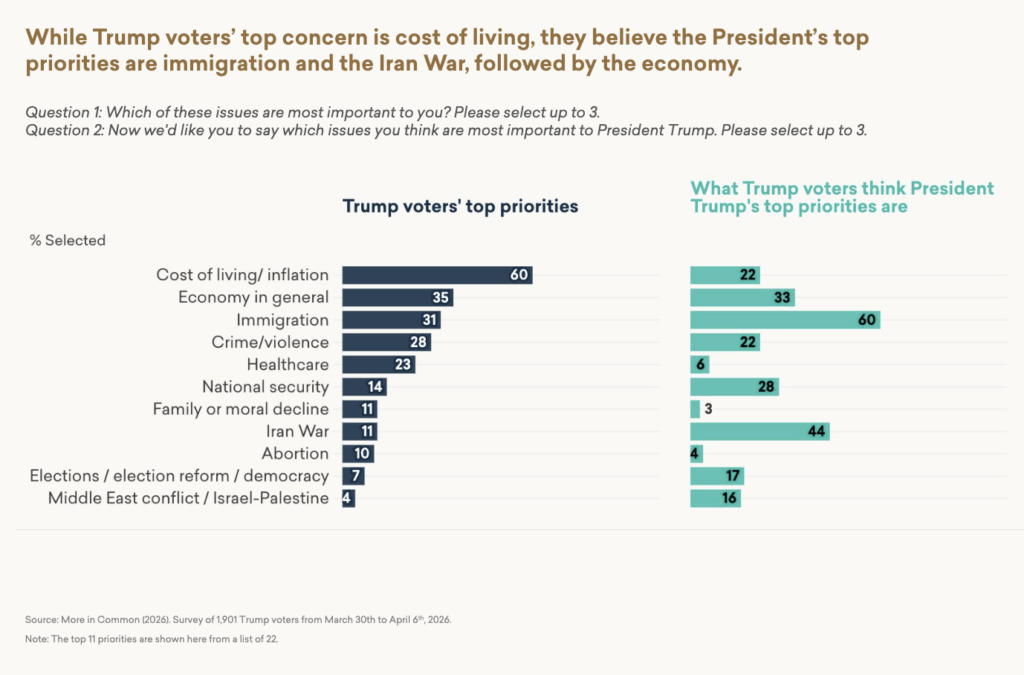
of Trump voters name the cost of living as their top concern. Only 11 percent think the cost of living is a priority for President Trump.
of the Reluctant Right say they have at least some regret about voting for President Trump, up from 13 percent in April 2025.
Explore the depth of our research at your fingertips. Get the complete insights by downloading the full report today.
What unites and divides Americans today? This newsletter takes a closer look at issues pressing on America’s social and political fabric and provides recommendations for how to strengthen ties to keep us bound together.